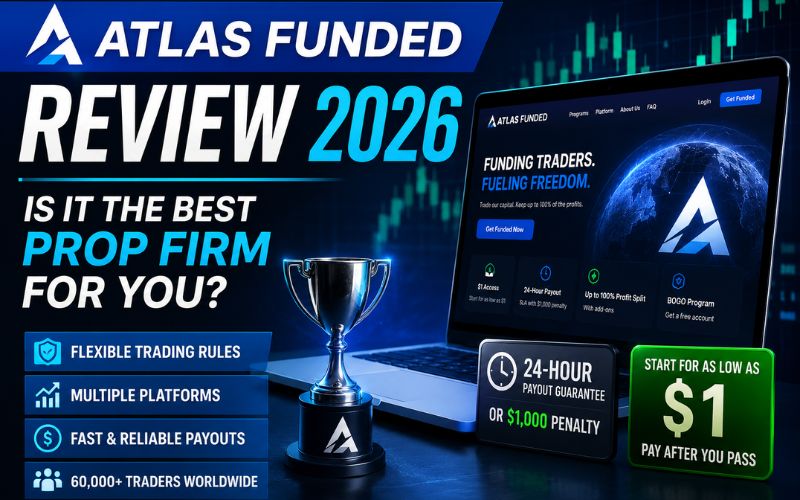

This comprehensive Atlas Funded review examines the firm’s unique pay-after-you-pass model, payout guarantees, and strict post-funding drawdown rules. The financial analysis team at Top10ex.com has evaluated their trading conditions to help you determine if this proprietary trading firm aligns with your risk management strategy. Read on for an unbiased breakdown of their offerings and platform reliability.
| Feature | Details |
| Founded | 2024 |
| Founder | Lucas Antonio |
| Registration | Saint Lucia (Company No. 2025-00597) |
| Maximum Allocation | Up to $400,000 |
| Challenge Types | 1-Step, 2-Step, Access, Instant Funding |
| Profit Split | 80% standard, up to 100% with add-ons |
| Drawdown Type | Static drawdown (most accounts), trailing drawdown (Instant Funding) |
| Platforms | MetaTrader 5, TradeLocker, Match Trader |
| Payout Frequency | Bi-weekly by default, weekly and on-demand options available |
| Payout Processing | 24-hour payout SLA on approved withdrawals |
| News Trading | Allowed during evaluations, restricted on funded accounts |
| Overnight Holding | Allowed |
| Weekend Holding | Allowed |
| Expert Advisors (EAs) | Permitted (excluding prohibited HFT strategies) |
| Supported Markets | Forex, Indices, Commodities, Futures, and Cryptocurrencies |
1. What is Atlas Funded and how does it work?
Atlas Funded is a proprietary trading firm founded in 2024 that provides simulated capital to traders who pass their specific evaluation phases. The company operates from the UAE and UK, offering account sizes up to $400,000 across multiple modern trading platforms.
Founded by Lucas Antonio in 2024 and officially registered in Saint Lucia (Company No. 2025-00597), Atlas Funded entered the market with a focus on evaluation accessibility. Rather than acting as a traditional broker that holds client deposits, the firm offers a simulated trading environment in which successful traders receive a percentage of the profits generated.
The evaluation process requires individuals to demonstrate disciplined risk management through various structured challenge formats. Once a trader successfully navigates these phases without breaching the maximum loss limits, they are granted a simulated funded account. At Top10ex.com, we noted that the firm currently supports over 60,000 registered traders across 140 countries, establishing a notable footprint in the prop firm landscape.
2. What makes Atlas Funded stand out in the prop firm industry?
The firm distinguishes itself with its unique Access model, allowing traders to begin evaluations for a minimal $1 to $10 upfront fee. It also features a strict 24-hour payout SLA backed by a $1,000 penalty and offers a Buy One Get One (BOGO) promotion.
The most distinctive offering from Atlas Funded is its Access evaluation model, which shifts a significant portion of the initial financial risk away from the trader. Instead of paying the full challenge fee upfront, users can start a 1-Step or 2-Step Access challenge for as little as $1 to $10. The remaining balance is only billed after the trader successfully passes the evaluation and proves their profitability.
Beyond its pricing structure, the firm places a strong operational emphasis on payout speed and reliability. They offer a 24-hour processing guarantee for approved withdrawals, with a $1,000 penalty fee if the company misses this deadline. While this is an attractive commitment that holds the firm financially accountable, traders must ensure they strictly follow all payout conditions to qualify.
Additionally, Atlas Funded utilizes structured promotional incentives to retain consistent traders over the long term. Their BOGO promotion automatically rewards traders with a free challenge account of the same size after they successfully secure their first payout. These structural features help the firm differentiate itself, though they must always be weighed against their specific post-funding trading restrictions.
3. Atlas Funded challenge types compared
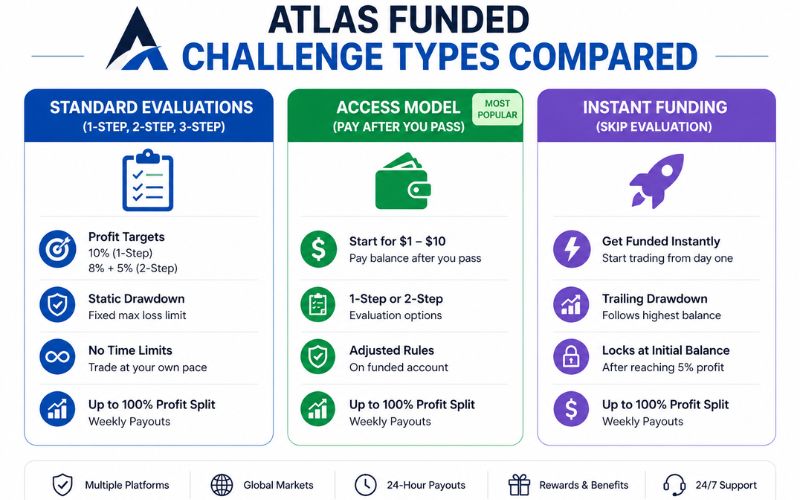
The firm provides a highly versatile selection of funding programs, including Standard evaluations, the revolutionary Access model, and Instant Funding. Each option is carefully tailored to match different trading styles and capital goals.
Choosing the right evaluation path is critical to maximizing your trading potential. Atlas Funded offers multiple formats, allowing you to select the precise parameters that best align with your personal methodology.
3.1. Standard evaluations (1-step, 2-step, and 3-step)
The Standard models offer a classic evaluation route with highly achievable profit targets. Traders can choose between a 10% goal in the 1-Step challenge or a combined 8% and 5% target in the 2-Step version.
A major advantage of these models is the strict use of static drawdowns, which provide a clear and fixed maximum loss limit. Furthermore, there are absolutely no time limits imposed, allowing you to trade comfortably at your own pace without unnecessary stress.
3.2. The innovative Access model
The Access program is Atlas Funded’s flagship offering, available in both 1-Step and 2-Step evaluation formats. It allows traders to begin their journey for a nominal upfront cost of $1 to $10, completely removing the initial financial burden.
Traders only pay the remaining balance after successfully clearing the evaluation phases. To maintain long-term sustainability, risk parameters are slightly adjusted on the funded account, which greatly encourages safe and consistent trading habits.
3.3. Instant funding program
For confident traders who want to skip evaluations entirely, the Instant Funding model provides direct and immediate access to tradable capital. This premium option allows you to start generating real profit splits from your very first trading day.
This model utilizes a trailing drawdown that tracks your highest account balance, rewarding impeccable risk control. Once your account reaches a 5% profit milestone, the drawdown favorably locks at the initial balance, giving you immense trading flexibility moving forward.
Looking to start with minimal upfront risk? Atlas Funded’s Access program allows traders to begin for as little as $1 before paying the full challenge fee after passing.
4. Trading rules and conditions
Atlas Funded provides highly flexible trading rules, allowing overnight holding, weekend holding, and Expert Advisors (EAs). While news trading is permitted during evaluations, standard profit deductions apply to live funded accounts to encourage safe execution.
Understanding risk parameters is the key to maintaining a healthy, long-term funded status. The firm publishes a transparent and easily accessible rulebook that supports a wide range of trading methodologies.
4.1. Drawdown rules
Atlas Funded primarily utilizes a highly trader-friendly static drawdown model across most of its accounts. This ensures your maximum overall loss limit remains fixed, regardless of your generated profits.
The major exception is the Instant Funding program, which uses a trailing drawdown that locks at your starting balance once you hit a 5% profit. Additionally, Access accounts transition from a 10% drawdown during the evaluation phase to a more controlled 6% limit once funded to promote long-term capital preservation.
4.2. News trading
Economic releases create immense volatility, and Atlas Funded manages this risk with a highly forgiving news policy. Traders enjoy complete freedom to trade high-impact events during all evaluation phases.
While news trading is permitted during evaluations, it is strictly banned on live funded accounts. You cannot open or execute trades five to ten minutes before and after high-impact economic news releases, and FOMC events are completely restricted.
4.3. Overnight and weekend holding
Swing traders can execute their strategies with absolute peace of mind on this platform. The firm fully permits holding active positions overnight and through the weekend.
The only restriction is that you cannot open new positions on Saturdays or Sundays. This flexible holding policy is ideal for traders looking to capture major weekly market trends.
4.4. Expert Advisors (EAs)
Algorithmic traders will find a highly supportive environment at Atlas Funded. The platform permits the use of strategy-based EAs, risk management indicators, and standard trading bots.
However, high-frequency trading (HFT) bots designed to place excessive orders in milliseconds are strictly prohibited. Traders are expected to maintain responsibility for their overall performance, whether executing trades manually or running automated systems.
4.5. Prohibited strategies
To maintain market integrity, the firm bans manipulative practices that exploit demo environment feeds. These rules ensure a professional trading environment for all participants.
Prohibited practices include latency arbitrage, tick scalping, account sharing, and trades held for under three minutes. Copy trading is permitted between your own personal accounts, but copying positions from other traders is strictly banned.
Try Now5. Platforms and instruments
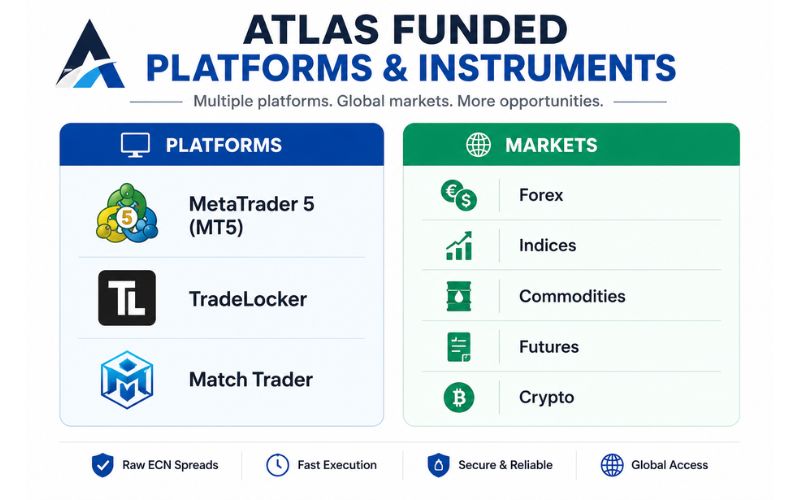
The firm supports three major trading platforms, including MetaTrader 5, TradeLocker, and Match Trader, equipped with raw ECN spreads. This diverse setup protects traders from vendor outages while offering access to forex, indices, commodities, and crypto.
Having multiple reliable platforms is essential for solid risk management in the modern prop firm space. Atlas Funded offers top-tier charting software alongside an expansive list of tradable assets.
5.1. MetaTrader 5 (MT5)
MT5 serves as the most familiar and powerful option for retail traders on the platform. It supports raw spreads, Depth of Market (DOM) pricing, and advanced automated trading features.
This platform is perfect for precision-focused day traders who rely on custom indicators and complex algorithmic setups. Note that US residents should confirm their MT5 accessibility with support before purchase.
5.2. TradeLocker
TradeLocker is a highly modern, web-based platform that integrates seamlessly with TradingView. It features built-in risk calculators, trailing stops, and responsive mobile charting.
This layout is clean, fast, and mobile-friendly, making it a favorite for traders who manage positions on the go. It provides a highly simplified trading experience without compromising on analytical depth.
5.3. Match Trader
Match Trader provides polished, desktop-level stability with smooth execution and live ECN spreads. It features an incredibly clean layout with zero commissions on indices.
This platform serves as a balanced middle ground, feeling faster than MT5 while offering more advanced charting than TradeLocker. Having multiple platform options ensures your trading is never interrupted by single-vendor licensing disputes.
5.4. cTrader (Optional)
For individuals who prefer advanced order execution, cTrader is available as a premium platform option. It is highly favored across the industry for its intuitive interface and high-speed execution.
Accessing this optional platform requires a small $15 add-on fee during your challenge checkout. It is a highly customizable choice for professional traders who demand the absolute best in execution software.
5.5. Tradable instruments
Atlas Funded provides a wide range of tradable assets to accommodate almost any trading style. Traders can easily diversify their risk across multiple global markets.
The available instruments cover major and minor forex pairs, stock indices, popular commodities, futures, and leading cryptocurrencies. These diverse asset classes are offered with tight spreads and simple, predictable fees.
6. Payouts and profit splits of Atlas Funded
Atlas Funded offers highly competitive profit-sharing arrangements starting at 80% and scaling up to 100% with checkout add-ons. Their unique payout system guarantees processing within 24 hours, backed by a direct $1,000 penalty if they exceed this window.
Securing your profits on time is the ultimate goal of any prop trading journey. At Top10ex.com, we analyzed how the firm’s payout schedules and reward programs compare with standard industry practices.
6.1. Payout speed and the bold 24-hour guarantee
The standout feature of Atlas Funded’s payout system is its strict processing speed. While most firms require several business days to approve withdrawals, this firm guarantees a 24-hour processing window.
To back this commitment, they promise a unique $1,000 penalty compensation if they fail to process an approved request on time. This creates an extraordinary level of financial accountability, ensuring that consistent traders are paid without delays.
6.2. Profit splits and withdrawal conditions
The platform starts with a standard 80% profit split across most of its challenge tiers. However, this ratio can be easily upgraded to a highly lucrative 100% split through simple checkout add-ons.
Standard withdrawals are processed on a biweekly cycle to ensure smooth capital flows. Traders can also opt for premium add-ons during registration to unlock faster weekly or on-demand payout schedules.
6.3. The fee refund and BOGO promotion
To support trader longevity, Atlas Funded implements a highly rewarding refund and promotional structure. The upfront challenge fee is fully refunded to you upon securing your fourth successful payout.
Additionally, the firm offers an aggressive BOGO (Buy One Get One) promotion after your first payout. Once you secure your initial withdrawal on a purchased account, you receive a second challenge account of the same size completely for free.
Traders who prioritize payout speed may find Atlas Funded’s 24-hour payout guarantee particularly attractive compared with traditional bi-weekly processing models.
7. Atlas Funded pros and cons
After reviewing Atlas Funded’s funding models, trading rules, platform options, and payout structure, several strengths and limitations stand out. While the firm offers several trader-friendly features, prospective users should also consider how its restrictions align with their trading style.
Pros
- Access challenges can be started for as little as $1 to $10 upfront.
- Static drawdown is available across most account types.
- Multiple platform choices, including MT5, TradeLocker, and Match Trader.
- Overnight and weekend holding are permitted.
- 24-hour payout processing guarantee on approved withdrawals.
- Profit splits can reach 100% through optional upgrades.
- Additional incentives such as fee refunds and BOGO promotions.
Cons
- Funded Access accounts operate under tighter drawdown limits than the evaluation phase.
- New trading restrictions apply after becoming funded.
- Instant Funding accounts use a trailing drawdown model.
- Certain features require optional paid add-ons.
- The company has a shorter operating history than some established competitors.
8. Is Atlas Funded safe and legit?
Atlas Funded displays several strong transparency markers, including public corporate registrations, platform diversity, and active community engagement. While the prop firm industry is unregulated, the firm’s 24-hour payout SLA and public ruleset build strong trader trust.
Evaluating the safety and legitimacy of a prop firm is essential before spending time and effort on an evaluation. At Top10ex.com, we performed a thorough due diligence check on the firm’s background and operational track record.
8.1. Corporate registration and leadership transparency
Atlas Funded is officially registered in Saint Lucia under Company No. 2025-00597, with operational offices based in both the UAE and the UK. The firm’s founder and CEO, Lucas Antonio, is a publicly identified figure who maintains active communication on social media.
This level of structural transparency is a reassuring sign in the proprietary trading industry. Unlike firms that collapsed due to hidden leadership, Atlas Funded maintains open communication and clear registration markers.
8.2. Trust indicators and community feedback
Atlas Funded has accumulated hundreds of public reviews on Trustpilot. As review counts and ratings can change over time, traders should check the latest Trustpilot profile before making a decision. The majority of positive feedback praises their prompt customer service, fast payouts, and highly transparent rule sets.
Some negative reviews mention drawdown breaches, which are common in the prop space as traders struggle with strict rules. However, the team actively responds to negative feedback publicly, showing a strong commitment to customer satisfaction.
8.3. Platform diversity as a risk management tool
One of the strongest trust indicators for Atlas Funded is its implementation of multiple trading platforms. By offering MT5, TradeLocker, and Match Trader, the firm protects its clients from unexpected vendor outages.
This diversified setup proved incredibly valuable during the 2024 industry-wide platform crackdowns. It ensures that a single licensing dispute will never lock traders out of their accounts overnight.
9. Who is Atlas Funded best suited for?
Atlas Funded is not necessarily the right fit for every trader, but its combination of low-cost evaluations, flexible holding rules, and multiple platform options makes it particularly attractive to several trader profiles.
The firm may be a strong choice for:
- Traders looking for a lower-cost entry point through the Access model.
- Swing traders who regularly hold positions overnight or through weekends.
- Traders who prefer static drawdown structures over trailing drawdowns.
- Users who rely on Expert Advisors or semi-automated trading systems.
- Traders who value faster payout schedules and frequent withdrawal opportunities.
On the other hand, traders who depend heavily on funded-account news trading or prefer firms with a longer operating track record may wish to compare Atlas Funded with other alternatives before making a decision.
10. Frequently asked questions
Finding clear answers to your questions about pricing and platform conditions can help prevent accidental rule breaches. Below are the most common inquiries compiled by traders reviewing this platform.
- How much does Atlas Funded cost?
The Access evaluation model starts at a highly affordable upfront fee of $1 to $10. Once you pass the evaluation, the full challenge fee is charged, ranging from $78 for a $5K account to $2,748 for a $400K account.
- Does Atlas Funded accept traders from the US?
Yes, US residents and citizens are fully accepted across all challenge formats and trading platforms. US clients should simply confirm MT5 access with the support team before purchasing.
- How fast are the payouts processed?
Payouts are guaranteed to be processed within 24 hours of approval on a bi-weekly schedule. If the company exceeds this window, it will compensate you with a direct $1,000 penalty fee.
- What happens if I breach my account rules?
If you violate a drawdown or strategy parameter, your simulated account is closed, and your outstanding balance is forfeited. However, you can reset or purchase a new evaluation at any time on your dashboard.
11. Verdict: Is Atlas Funded worth it?
To conclude our Atlas Funded review, the firm is highly recommended for disciplined forex traders who want to bypass heavy upfront fees. Their unique access model, combined with a strict 24-hour payout SLA, makes it a top-tier choice.
If you are ready to secure a funded account with minimal initial risk, explore their challenge formats today. For more advanced trading guides and expert prop firm comparisons, visit our comprehensive resources at Top10ex.com.
Learn More